How I built two published research reports with Claude — and what the learning curve actually looked like
The honest backstory. Not the polished version — the actual sequence of experiments, failures, and discoveries that took a framework from first frustrated prompt to SSRN publication in four months. The Stellaris Meta-Framework supplied the analytical core. The proof sits on SSRN. This module documents how the build actually ran.
The central claim
The Stellaris Meta-Framework bonds two independent theories into one analytical model. Tony Seba's Technology Disruption Framework maps how Wright's Law cost curves force economic transformation from the bottom up, regardless of political intention. Neil Howe's Fourth Turning generational theory maps how eighty-to-one-hundred-year generational cycles drive institutional legitimacy crises at regular intervals. Neither framework alone generates the key forecast. The synthesis does.
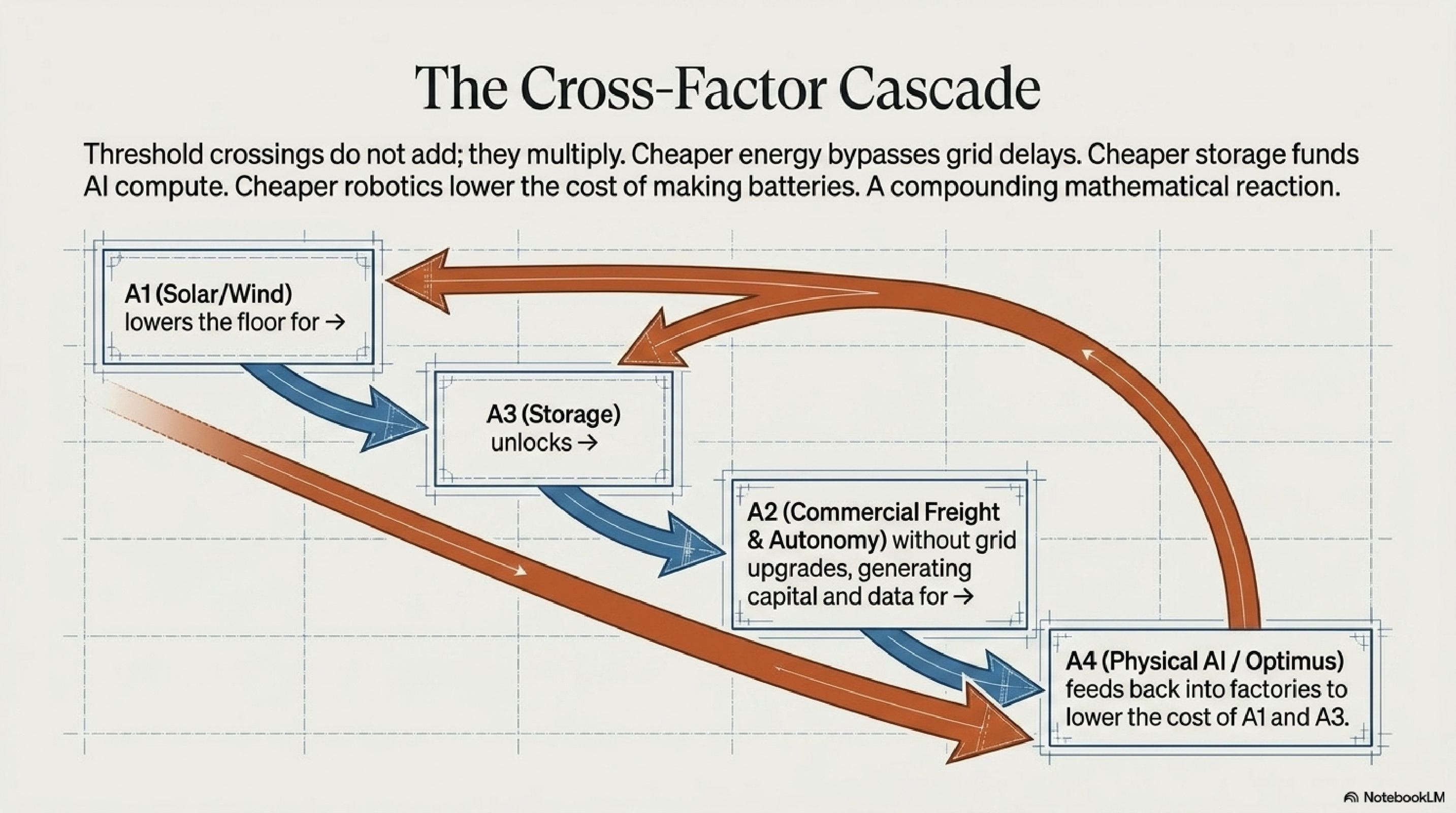
Five factors that form the foundation of every prior economic order — energy, transportation, labor, knowledge, and food — each cross a disruption threshold inside the 2025 to 2032 window. That window coincides with the Fourth Turning Crisis reaching the climax phase. The concurrent arrival causes the transformation. Neither timing alone produces the outcome. The convergence does.
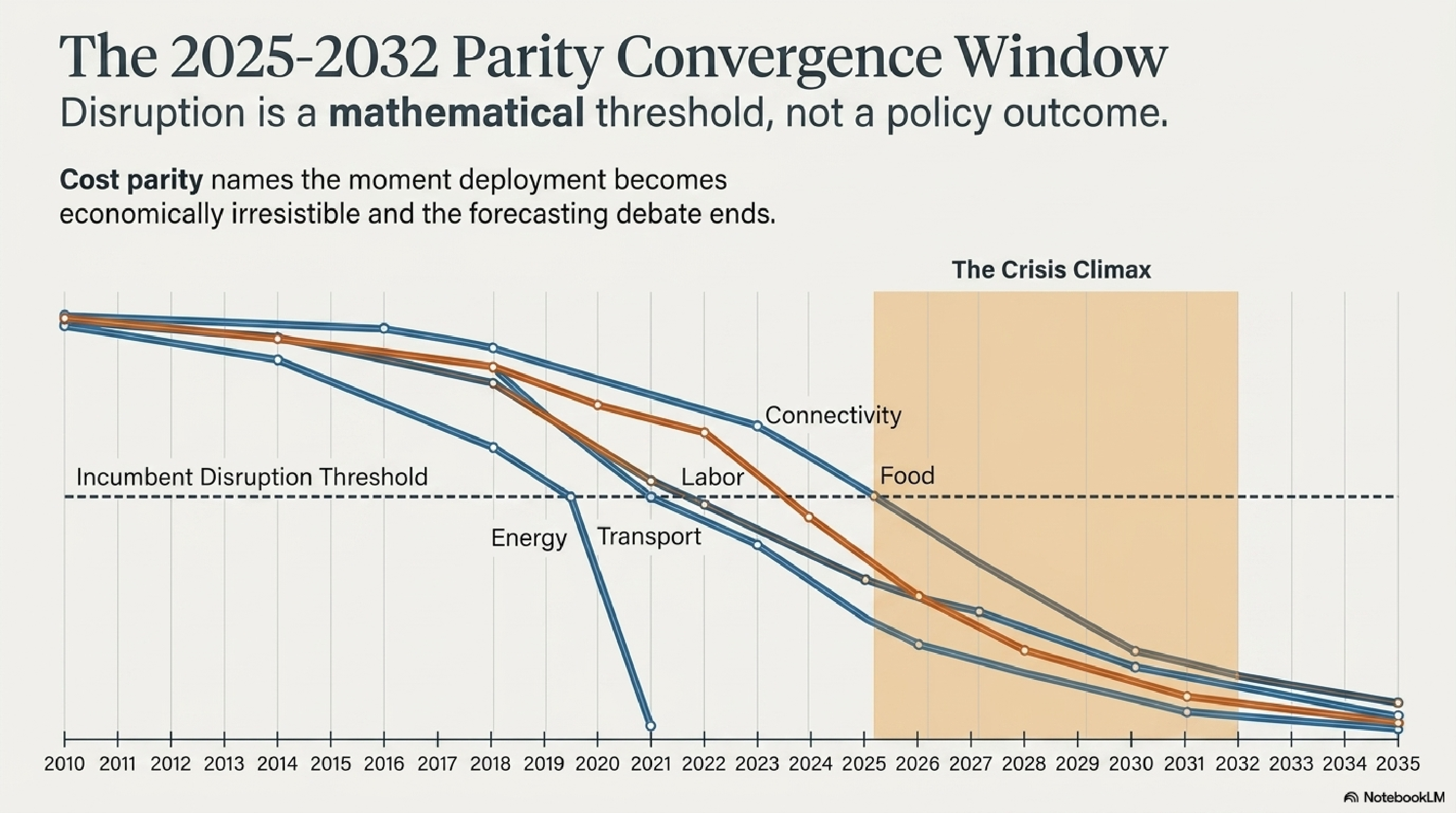
Wright's Law: the engine underneath everything
Theodore Wright documented the pattern in 1936 while studying aircraft manufacturing. Every time cumulative production of an aircraft doubled, manufacturing costs fell by a consistent percentage. Wright named the relationship. Engineers called the resulting trajectory a learning curve.
Tony Seba recognized something Wright never anticipated. When a learning-curve cost descent crosses a critical disruption threshold — the parity moment where a new technology undercuts the old on pure economics — disruption stops being a forecast and becomes a structural certainty. The framework does not forecast that solar electricity might undercut coal-fired electricity on price. The framework identifies the price level where the cost math makes the outcome inevitable, then tracks the cumulative production doublings that drive costs toward that level and beyond.
Wright's Law operates independently of the motivation behind the production volume. China commits manufacturing resources to solar panels and batteries for energy independence. Europe commits for security reasons after February 2022. The United States commits through the Inflation Reduction Act for industrial competition reasons. The political motivation differs across all three. The cumulative production volume compounds regardless. Wright's Law runs on cumulative doublings, not on the intentions of the actors generating those doublings.
The four questions
The Stellaris Meta-Framework answers four questions no prior analytical model addresses together. Each question maps to a distinct body of theory. The synthesis answers all four as an integrated system.
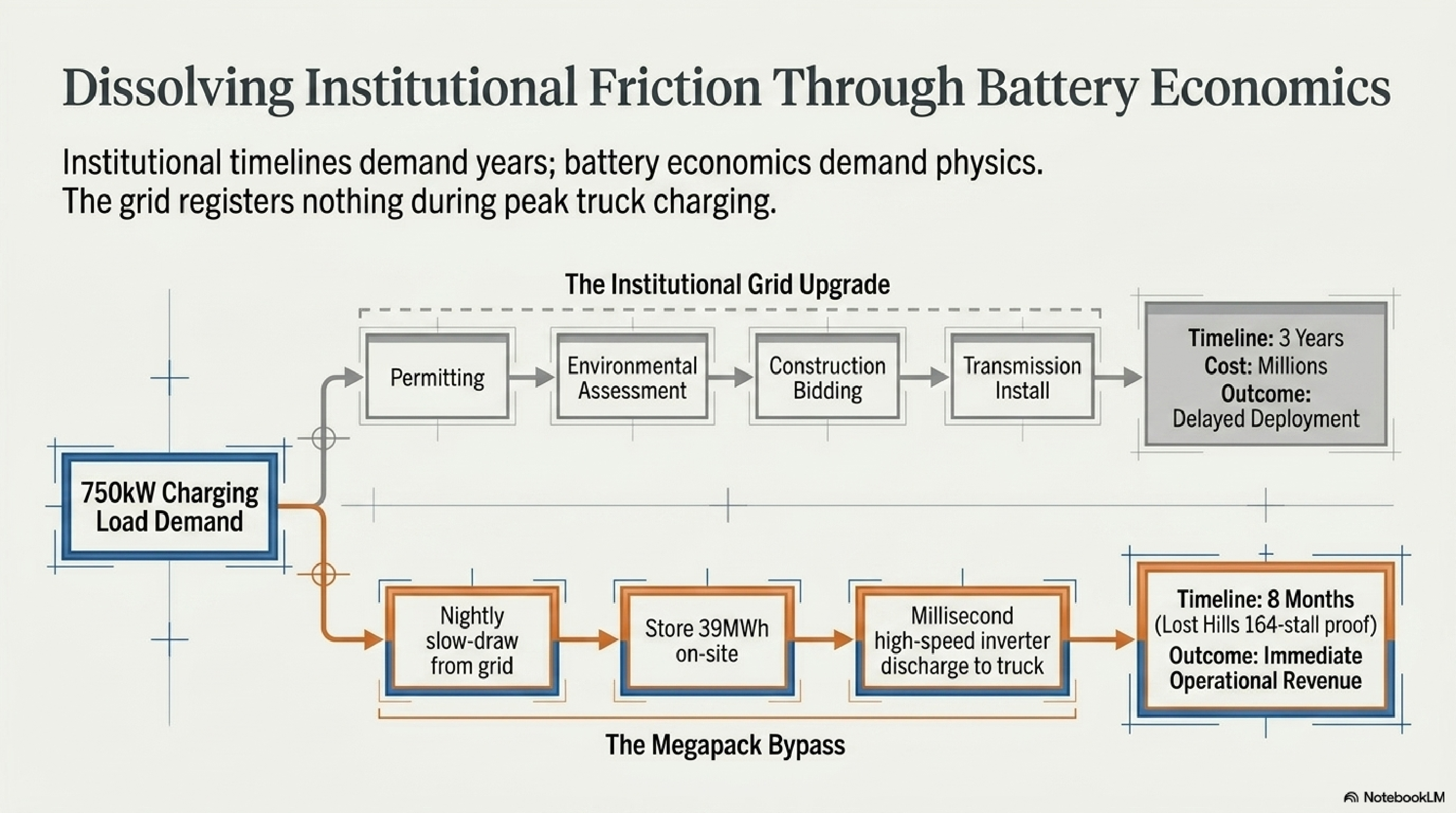
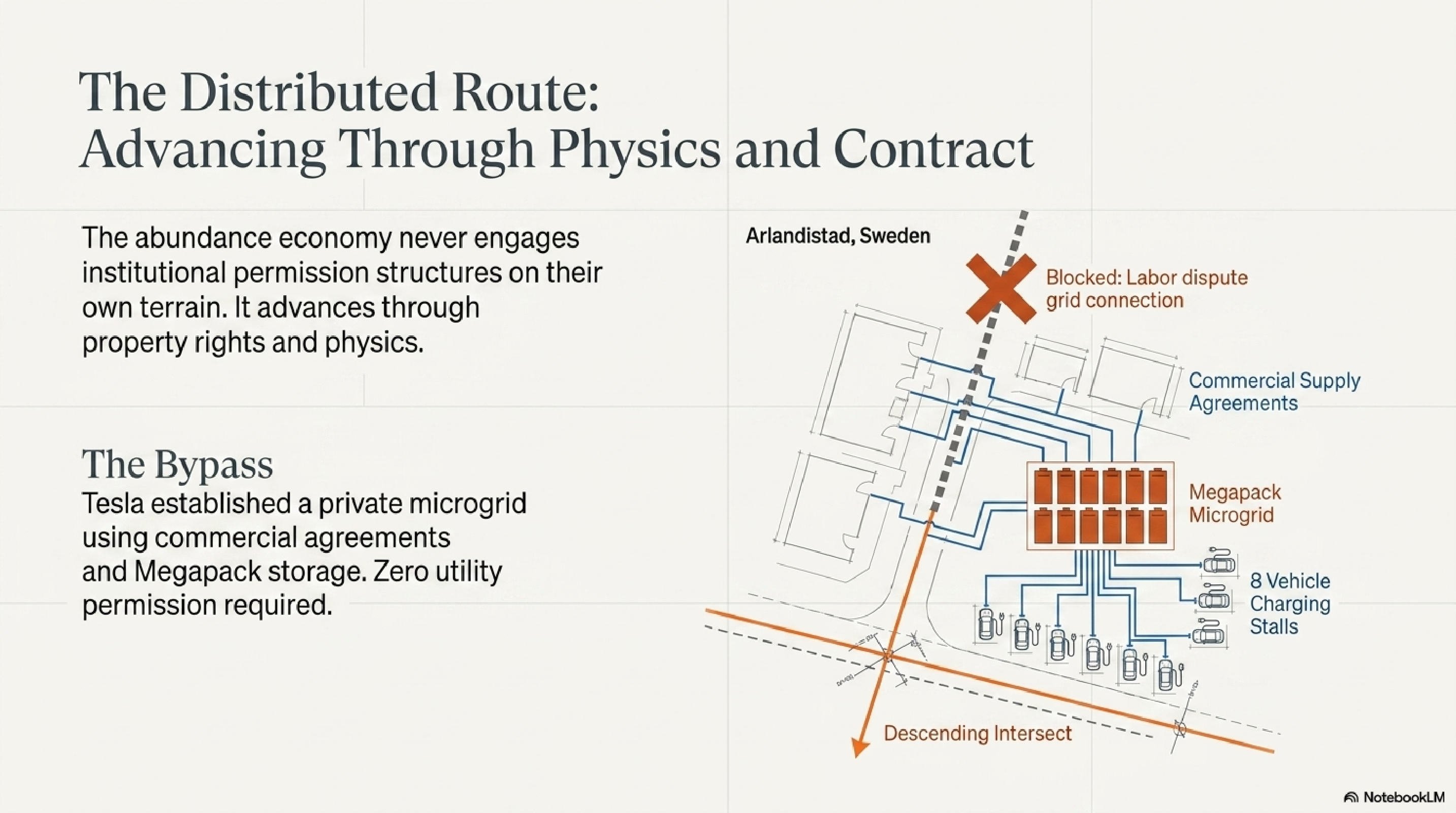
The Organizing System: why cost curves alone never determine outcome
Wright's Law drives cost curves through parity thresholds. Cost curves crossing parity do not automatically transform the economy. Arbib and Seba identified the missing piece in Rethinking Humanity (2021): the Organizing System.
The Organizing System names the full architecture of technologies, institutions, laws, social structures, and values that coordinates how a civilization produces and distributes goods and services. When five foundational factors cross capability thresholds simultaneously, the extraction Organizing System loses the technical foundation. Two outcomes become possible: breakthrough — a new Organizing System forms and allows the abundance economy to deploy at scale — or breakdown, the darker alternative Arbib and Seba call a "new dark age."
The Stellaris framework bonds Seba's threshold analysis with Howe's generational theory to address the breakthrough-or-breakdown question directly. Wright's Law crosses the thresholds. The Fourth Turning crisis climax disrupts the institutional order that the incumbent extraction economy depends on. The generational archetypes determine whether new institutional architecture fills the vacuum or whether something worse fills the vacuum.
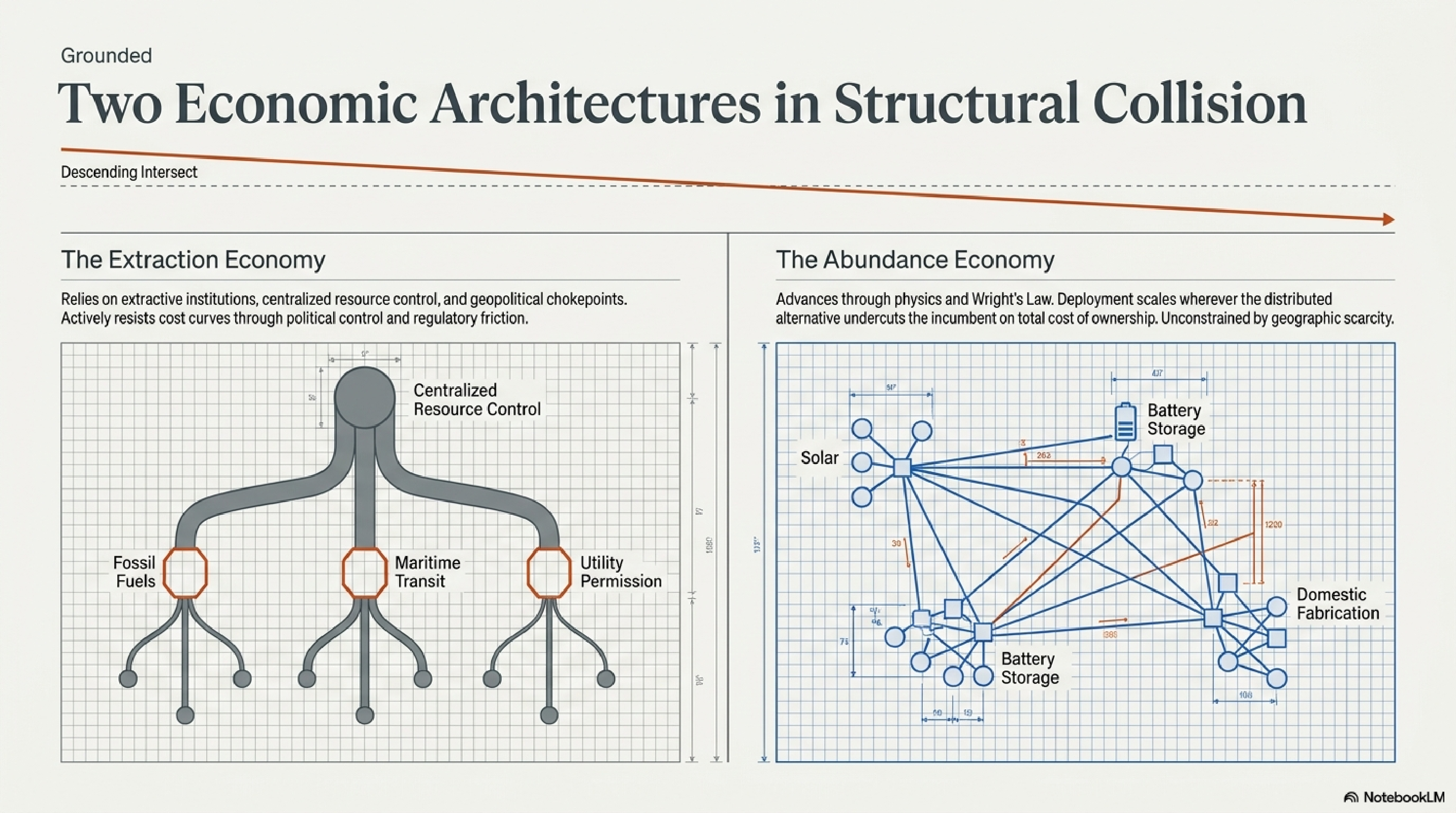
"Washington never planned this. Beijing never planned this. And that captures the point precisely. Two geopolitical rivals, locked in the most consequential technological competition in modern history, accidentally collaborate to deliver something no climate treaty produced in thirty years."
The structure of the report
The full report spans four parts and thirteen chapters, plus a conclusion and appendices. Part I states the synthesis and explains why the bond between the two source theories generates forecasts neither produces alone. Part II walks each of the five disruption threshold crossings in sequence. Part III explains why the 2025 to 2032 alignment window matters beyond coincidence. Part IV addresses the governance question: what institutional architecture does the coming order require, and how does the reconstruction generation build that architecture before the crisis closes.
The next three modules in this series — the learning curve, CLAUDE.md, and the build discipline — document the methodology that produced this report. The framework content and the process documentation exist as separate tracks. A reader with no interest in the AI workflow can follow the framework alone. A builder who wants to replicate the methodology can follow the process track. Both tracks start here.
Cut and paste drives the entire workflow. Not prompting theory. Not AI expertise. Claude produces a draft. You cut the passage that works, paste the passage into your document, and discard the rest. Every other skill in this workflow builds on that mechanic.
The feedback loop
The Stellaris project did not run in a straight line from research to publication. The actual process cycled through six phases repeatedly — each pass through the loop strengthening the analytical architecture and adding empirical precision. The loop never fully closes. New reading surfaces new ideas. New ideas open new gaps. Gaps drive new research. The discipline tools — CLAUDE.md, version control, session rules — exist to keep the loop sustainable across weeks and months, not just individual sessions.
The light blue nodes mark analyst-only work: reading and discovery happen away from Claude. The solid blue nodes mark the collaborative work: synthesis, drafting, research, and revision run through Claude with the analyst directing each step. The loop returns to Read every time the Discover phase surfaces a gap the existing sources don't fill.
The four documents that carry the project
The Stellaris project did not begin with a finished framework and a request to write a report. The project began with a central claim and a set of source theories, then built outward through sustained analytical iteration with Claude. The workflow rests on four documents that together define the operating parameters for every session.
How a session works
Every productive session follows a consistent structure. Claude reads the CLAUDE.md operating manual and the relevant reference documents at the start. The analyst provides the research question or drafting task. Claude produces a first draft against the style standard. The analyst revises specific paragraphs, never the whole document. The cycle repeats until the passage meets the standard.
The operating manual matters more than any individual prompt. A prompt without context produces generic output. A prompt from inside a well-defined project — with vocabulary rules, behavioral standards, source hierarchies, and file paths already established — produces work the analyst can actually use. The CLAUDE.md file carries that context from session to session and eliminates the cold-start problem that breaks most long-form AI research projects.
Session discipline — how I manage usage
The session loop works. These rules keep the loop from breaking.
Protect the session
-
1Turn off battery-saver sleep mode and keep the laptop plugged inSleep breaks an active Cowork session mid-task. Restarting means reloading context — avoidable with one power setting. On a Mac: System Settings → Battery → turn off sleep when on battery power.
-
2Ignore "Relaunch to update" until the session endsRelaunching mid-session reboots Claude and wipes active context. The update prompt appears frequently — ignore the prompt until the current session ends naturally. Finish the work first, then relaunch. Updates accumulate and install on the next restart.
-
3Start a fresh session when Claude starts driftingWhen a conversation runs long or Claude begins losing track of earlier instructions, start fresh. A context load at the top of a new session costs two minutes. A confused session that produces work you have to discard costs far more.
Keep prompts lean
-
4Don't ask Claude to load the whole document on every promptReference the specific section or paragraph by name. Loading a 26,000-word report to revise one paragraph wastes the session's context on content Claude doesn't need. Name the section. Paste the paragraph. Keep the scope tight.
-
5Scope each prompt to one taskDraft, Revise, Analyze, or Check — not all four at once. A prompt that asks Claude to draft a new section, check the previous section for gaps, and revise the introduction produces weaker output on all three tasks than three focused prompts.
-
6Tell Claude exactly what to deliverWhen requesting a revision, paste only the specific passage — not the full section. Specify the output: "provide only the revised paragraph, not the full section." Don't ask Claude to summarize what Claude just produced. That turns the session into a recap rather than a build.
Manage versions
-
7Version by authorship, not just sequenceClaude increments the whole number when a prompt produces a new draft (v1 → v2). You increment the decimal when you make your own manual revisions (v2 → v2.1). Keep the system loose — clarity about which file to hand Claude next matters more than a formal audit trail.
-
8One live file at all timesArchive all prior versions separately. One active file eliminates the question of which version Claude should work from. Reference files by path in the prompt rather than pasting content — the CLAUDE.md carries the standing instructions and keeps each prompt short.
Example prompts from the Stellaris build
These prompts appear in the actual Stellaris development workflow. The structure of each prompt matters as much as the content. Each prompt references the established documents rather than re-explaining the project from scratch.
What Claude does and does not do in this workflow
Claude produces first drafts, revises specific passages, identifies logical gaps, checks consistency against the Dictionary of Terms, and applies the writing style standard. Claude generates independent analysis and numerical estimates, then states explicit confidence levels on all claims.
Claude does not determine what the framework argues. The analyst sets the central claim and the analytical architecture. Claude executes against that architecture with precision. The framework reflects the analyst's judgment. Claude provides the drafting power and the error-checking that makes sustained development across hundreds of sessions practical.
The methodology applied to your domain
The Stellaris workflow applies to any research domain where a central claim requires sustained analytical development across multiple chapters. The subject matter changes. The structural requirements stay constant: a clear central claim, a vocabulary document, an operating manual, a prose standard, and a chapter-by-chapter development plan.
The five steps below map directly to what the Stellaris project built. Each step produces a document. Those documents, together, define the operating environment that makes long-form AI-assisted research practical at publication quality.
The five steps don't produce your research. The five steps build the infrastructure that lets the feedback loop run. Once the central claim, vocabulary document, operating manual, prose standard, and chapter outline exist, every session advances the loop — Read, Synthesize, Draft, Research, Revise, Discover — rather than re-establishing context from scratch. Step 5 doesn't finish the project. Step 5 starts the loop.
Five steps
-
1State the central claim in one sentenceEvery productive framework starts with a falsifiable claim — not a topic, not a question, but a claim. The Stellaris claim: five factor crossings inside the 2025–2032 window converge with the Fourth Turning crisis climax, and the convergence causes the transformation. Write your equivalent sentence before building anything else. The claim determines what the vocabulary document needs and what evidence the chapters must assemble.
-
2Build the vocabulary documentIdentify every term in your domain that carries a technical meaning distinct from everyday usage. Define each term precisely. Establish what the term includes and what the term excludes. The Stellaris Dictionary of Terms v3.1 defines 60+ terms across five thematic sections. A vocabulary document this precise eliminates the ambiguity that degrades analytical consistency across long projects. Claude reads this document at the start of every session.
-
3Write the operating manual — your CLAUDE.mdThe operating manual specifies the project's central claim, the document file paths, the vocabulary rules, the capitalization standards, the behavioral expectations (state confidence levels, flag gaps, lead with the counterargument), the forbidden constructions, and the output format preferences. A complete CLAUDE.md turns every new session into a continuation of the project rather than a cold start. This document carries more analytical value than any individual prompt.
-
4Define the prose standardThe Stellaris project uses the Master Writing Style Sheet — a specific set of rules that eliminate weak verb forms, passive constructions, vague pronouns, and structural habits that obscure analytical precision. Adapt the Style Sheet to your domain and reading level. The rules do not need to match the Stellaris rules exactly. The rules do need to be explicit enough that Claude can apply them consistently without re-explanation each session.
-
5Develop chapter by chapter — never the whole documentBuild an outline first. Assign each chapter a single claim to prove. Then develop each chapter through the iteration loop: Claude drafts, the analyst revises specific passages, the cycle repeats. Never ask Claude to rewrite the whole document. Provide only the specific paragraphs that need revision, labeled by section. This discipline keeps the analyst in control of the analytical architecture while Claude handles the drafting power.
What this produces
The Stellaris project ran this workflow from January 2026 through April 2026 — four months from first serious prompt to SSRN publication. That timeline reflects a feature of the methodology, not an accident of pace. When the operating documents define the analytical architecture precisely, each session advances the work rather than re-establishing context. The result: a ~26,000-word analytical report on SSRN (DOI: 10.2139/ssrn.6692598), a companion Tesla analysis at ~8,700 words (DOI: 10.2139/ssrn.6721118), a 103-term Dictionary of Terms at ~11,000 words, and a standalone Appendices document. The full corpus across all documents runs approximately 50,000 words.
You do not need expertise in infrastructure economics or generational theory to run this workflow. You need a central claim worth defending, the discipline to define terms precisely, and the willingness to revise specific paragraphs rather than whole documents. Any research domain that meets those requirements can run this workflow.
Where the process documentation goes next
Module 1 documents the learning curve — what the early sessions actually looked like, what bad prompts produce, and what changed when the operating documents came into place. Module 1 does not present a polished methodology. Module 1 presents the failures that made the methodology necessary.
Two failures in particular shape the learning curve. The first: early sessions ran without feedback loops. A prompt produced a draft, the analyst accepted the draft, and the session ended. No gap-checking. No research pass. No return to Read. The output looked complete. The analytical architecture had holes. The feedback loop discipline — Discover, return to Read, revise — developed because linear sessions produced work that looked finished but couldn't withstand scrutiny.
The second failure runs deeper. When I told my granddaughter I was using Claude to write, she said immediately: people who use AI for writing often can't explain what they wrote. She was right — and I recognized the problem in myself. When Claude handled the revisions, I skimmed the output. I approved sentences I hadn't fully read. The report grew longer. My understanding of the argument didn't grow with the report. The fix turned out to be the most basic mechanic in the workflow: cut and paste. The act of cutting a passage out of Claude's draft and pasting the passage into the document forced me to read the sentence, understand the section under revision, and decide whether the argument held. Passive approval produces a report you can describe but not defend. Cut and paste produces a report you own. Module 1 examines that distinction in full — between a report you commissioned and a report you built.
One symptom appeared repeatedly: the same point showed up in multiple sections, worded differently, because no single session saw the full document. A dedicated prompt — ask Claude to find all repetitions in the report, then decide for each one whether the repetition serves the argument or just fills space — became a standard step. Claude can locate the repetitions. Only the analyst can decide whether a repeated point reinforces a claim or reveals that the argument hasn't advanced. That decision requires understanding the argument.