Claude Cowork · Practitioner journal

Serious work with Claude.
No coding required.

You want to use Claude for real professional work — research, analysis, publication-quality writing. You are not a developer. Almost nothing exists to show you how. This site does.

Proof of work — Jan to Apr 2026
~26,000
Words — Stellaris Meta-Framework Report
Published SSRN · April 2026
~8,700
Words — Tesla: The Four-Threshold Company
Published SSRN · May 2026
4 months
First prompt to published research
January → April 2026

The honest origin story

Two published research reports. No coding background. No methodology. The learning curve started earlier than January 2026 — and that backstory matters.

The writing started in 2023 — a handful of articles on Tesla, EV adoption, and the Fourth Turning. Nothing sustained. 2024 produced one post. In early 2025, the house sold and I moved to an apartment. Writing resumed that spring: Stellar World analysis, Fourth Turning essays, the first family history posts. By November 2025, I was deep into genealogical narrative — fourteen chapters of the Turnock-Hinkel family history in a single month.

Somewhere in October 2025, I started using the free Claude Chat. I had no system. I had no memory of what I had told Claude the session before. I had no idea CLAUDE.md existed.

On January 16, 2026, I paid for the first subscription. Eleven days later, I published the first Stellaris Meta-Framework post. Two years of reading had built the pieces: Wright's Law, the Fourth Turning, the five production factors. The framework finally had a structure worth committing to.

I wrote bad prompts. I discovered CLAUDE.md by accident. I discovered Cowork weeks later. By April 2026, I had published the Stellaris report on SSRN. The Tesla analysis followed in May. Four months from first serious prompt to two published reports with DOIs.

This site reconstructs that learning curve — the full arc from 2023 writing experiments through the tools and workflow that eventually produced publication-quality research. The reports are the proof. The process documentation is what you can use.
1
2023 — early writing
First writing: Tesla and the Fourth Turning
A handful of articles on Tesla moats, EV adoption, and Fourth Turning theory. Sporadic. No sustained framework. One post in all of 2024.
2
October 2025
First use of Claude — free tier, no system
Family history writing was already running — fourteen Turnock-Hinkel chapters in November alone. Claude Chat entered the workflow with no memory, no CLAUDE.md, no methodology. Just a free account and trial and error.
3
January 16, 2026
First paid subscription — and first Stellaris post
Eleven days after subscribing, the first Stellaris Meta-Framework post went live. The framework built across two years of reading finally had a structure worth committing to.
4
February 2026
Discovery: CLAUDE.md and Cowork
A project operating manual that Claude reads every session eliminated the cold-start problem. Cowork added direct file access and a persistent workspace. The workflow became a continuous build process.
5
April–May 2026
Publication
Stellaris Meta-Framework Report published on SSRN in April. Tesla: The Four-Threshold Company follows in May. Both carry DOIs and full citations. Four months from first serious prompt to two published reports.
Two audiences, one site

Where do you want to go?

Read the analytical work, or learn the process that produced the work. Both paths start here.

For readers

The analytical work

The Stellaris Meta-Framework and the Tesla analysis represent the outputs of the Cowork build process. Read the frameworks, the evidence, and the conclusions — no interest in AI tools required.

  • Stellaris Meta-Framework Report — Wright's Law, the Fourth Turning, and the architecture of the coming economic order
  • Tesla: The Four-Threshold Company — how Tesla crossed four simultaneous disruption thresholds
  • Dictionary of Terms — the analytical vocabulary of the Stellaris framework
Read on SSRN →
For builders

The process

Learn what the Cowork build process actually looked like — the mistakes, the discoveries, and the workflow that took a research framework from first frustrated prompt to SSRN publication in four months.

  • The learning curve — what bad prompts look like and why they fail
  • CLAUDE.md — what a project operating manual does and how to build one
  • The writing standard — how a style sheet eliminates inconsistency across hundreds of sessions
  • The build discipline — why you revise paragraphs, never whole documents
Start the process →
Published outputs
Research report · SSRN
The Stellaris Meta-Framework Report
~26,000 words · Published April 2026
Wright's Law, the Fourth Turning, and the Architecture of the Coming Order.
DOI: 10.2139/ssrn.6692598
View on SSRN ↗
Research report · SSRN
Tesla: The Four-Threshold Company
~8,700 words · Published May 2026
How Tesla crossed four simultaneous disruption thresholds and what the crossings mean for the coming order.
DOI: 10.2139/ssrn.6721118
View on SSRN ↗
Reference document
Dictionary of Terms v3.1
~11,000 words · 60+ defined terms
The analytical vocabulary of the Stellaris Meta-Framework across five thematic sections. Defines every term that carries a technical meaning distinct from everyday usage.
Flashcard deck →
Analytical deep-dive · Infographic series
The Integration Stack — Visual Analysis
20 infographics · May 2026
A structural walk through the four threshold crossings, the Integration Stack architecture, and the geopolitical validation of the cost curves — with annotated visuals from the Tesla analysis.
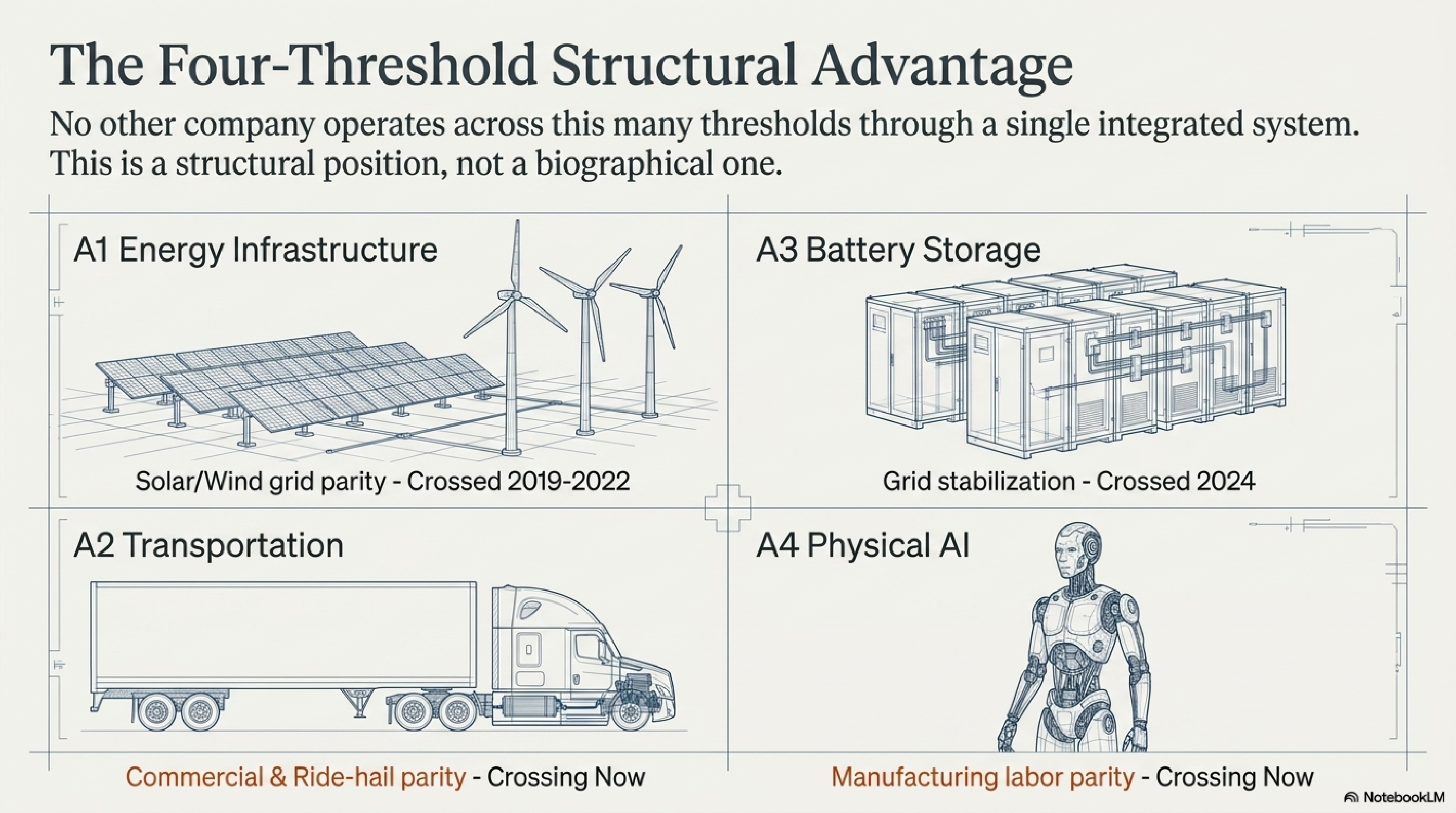
The Four-Threshold Structural Advantage — A1 Energy, A2 Transportation, A3 Battery Storage, A4 Physical AI Explore the analysis →
Study the framework

65 flashcards drawn directly from the Stellaris Meta-Framework Report. Click a card to reveal the answer. Use the arrows to move through the deck, or shuffle for a random order.

Card 1 of 65
Question
Click to reveal answer
Answer
Click to return
About this site

A practitioner's journal, not a course

Practice. Build. Publish. exists because the Cowork documentation gap is real. Anthropic's product documentation explains what Cowork does. Nothing explains what a non-developer can actually build with Cowork — or what the learning curve looks like for someone who arrives with a serious research project and no technical background.

This site fills that gap with one practitioner's documented experience. The Stellaris and Tesla reports are the proof of work. The process documentation reconstructs how Richard built those reports — the failures, the wrong turns, and the discoveries that changed how the work ran.

The site carries no monetization, no course fees, and no product to sell. Richard Turnock is retired and publishes the Stellaris framework as independent research. The process documentation exists to save the next serious non-developer several weeks of frustration.

Richard Turnock
Independent research analyst · Stellaris Meta-Framework
Retired analyst. Publishes infrastructure economics and technology disruption research using the Stellaris Meta-Framework. Built two SSRN-published reports using Claude Cowork between January and May 2026.